
If Your Coaches Work With Symbai

Symbai actively recruits experienced debate coaches to lead live online cohorts.

We recognise that many of the strongest coaches are already embedded within established academies, schools, and university programmes. For that reason, Symbai coaching agreements are non-exclusive.

If one of your coaches works with Symbai, they remain free to continue all existing commitments within your academy. We do not require exclusivity.

All coaches are required to confirm that their work with Symbai does not conflict with existing contractual obligations. We expect transparency and professionalism in all engagements.

Our Mission

Symbai’s long-term mission is to help structured debate take root more deeply within education systems worldwide.

You can read more about that commitment on our mission page.

Live coaching supports that mission by ensuring our platform evolves through real debate practice, not just theory.

Why We Run Live Cohorts

We don’t run coaching to scale headcount — We run it to stay embedded in real debate rooms and real school systems.

Live coaching keeps us accountable to performance and school partnerships let us influence how structured debate takes root inside education.

Structured cohorts across ability levels, bringing together debaters from different regions, formats, and competitive cultures.

Working across geographies and levels ensures that our coaching approaches remain adaptable and grounded. 

We coach as a real academy would: prioritising student growth first, adjusting tools when they serve learning, and setting them aside when they do not.

When coaching reveals pain points that software could solve, that is where product refinement begins. Not before.

Cohorts are intentionally capped to preserve rigor, meaningful feedback, and genuine developmental standards.


A structured capability-transfer model — not permanent external coaching.

Schools engage our coaches for a defined period to model high-performance use of Symbai, co-coach alongside staff, and then transition leadership internally.

All materials and structures developed remain with the school, supporting long-term integration of structured debate across subjects.

As debate becomes visible and institutionally embedded, more students pursue competitive pathways — strengthening the wider ecosystem in which academies operate.

Most edtech companies ship features — We test ours under competitive pressure and inside institutions that need them to last.

Because our ambition isn’t to build a tool — It’s to help make structured critical thinking a permanent part of education.

What This Means for Your Academy

When one of your coaches works within Symbai, they gain:

  • First-hand experience with evolving AI-enhanced tools

  • Insight into structured, data-rich coaching systems

  • Exposure to measurable progress tracking

  • Practical understanding of how AI integrates with live debate

Because our agreements are non-exclusive, academies may choose to explore short-term collaboration as a practical way to understand the platform in depth before considering wider integration.

Growing the Ecosystem

As structured debate becomes more embedded within classrooms globally, its credibility and visibility rise.
When more students experience argumentation as part of everyday learning:

More Students Push Higher

As structured debate becomes normal in classrooms, more students are ready for serious competition — raising the ceiling of what elite coaching can achieve.

Skill Growth Becomes Visible

As Symbai tracks critical thinking in classrooms, improvements driven by academy training show up in measurable school data — reinforcing the real ROI of elite coaching.

Debate Moves Toward the Centre

As debate gains academic legitimacy, more schools look to external academies to achieve excellence — increasing demand for high-level competitive coaching.

Academies are essential to that future

Symbai’s long-term focus is infrastructure — building systems that make debate more central within education itself, so the entire field can grow stronger and more sustainable.

Open Conversation

If you lead a debate academy and would like to discuss how Symbai fits into your long-term strategy, we welcome a direct conversation.

Expanding the role of debate within education requires thoughtful collaboration across the ecosystem.
The Two Most Effective Ways to Improve Critical Thinking

Unified in Symbai

Debating

Hundreds of thousands of students across 60 countries choose to spend their free time in formal debating competitions because it improves their critical thinking skills. 

Formal debating improves:

  • Dynamic reasoning — adapting ideas under pressure

  • Strategic thought — anticipating and countering objections

  • Cognitive discipline — structuring arguments with clarity and purpose

Increases Critical Thinking By Up To 50%

Competitive debate produces greater critical thinking improvement than argumentation courses.
Allen et al. measured the improvement using the Watson–Glaser critical-thinking test — a gold-standard assessment of inference, deduction, and evaluation skills.”
Source

8.6% Critical Thinking Gains In Just 3 Weeks

Students who participated in debate competition showed statistically significant improvements in critical thinking scores after just three weeks.
An 8.6% improvement in critical thinking is the cognitive equivalent of dropping your resting heart rate from 70 to 64 BPM. That's not learning facts or techniques — that's developing lasting cognitive fitness.
Source

9 in 10 former debaters go on to earn at least one advanced degree.

Of 703 National Debate Tournament alumni, over 90% held a graduate or professional degree, and many held multiple advanced degrees.
Of the 703 former NDT debaters; 40% earned master’s degrees (MA, MSc, MBA, MEd, etc.), 20% earned doctoral degrees (PhD, MD, EdD) and many held multiple advanced or professional degrees.
Source
Argument Mapping

Argument mapping has been around for hundreds of years, used by philosophers, scientists, and modern critical-thinking educators to make critical thinking clearer by drawing it out.
And for good reason: when done well, argument mapping is one of the most effective ways to improve critical thinking and develop sharper logical reasoning.

Argument mapping helps you:

  • Clarify reasoning by revealing the actual structure of your thinking
  • Expose weak links that get lost in normal prose
  • Build precision through visual logic rather than persuasive writing tricks
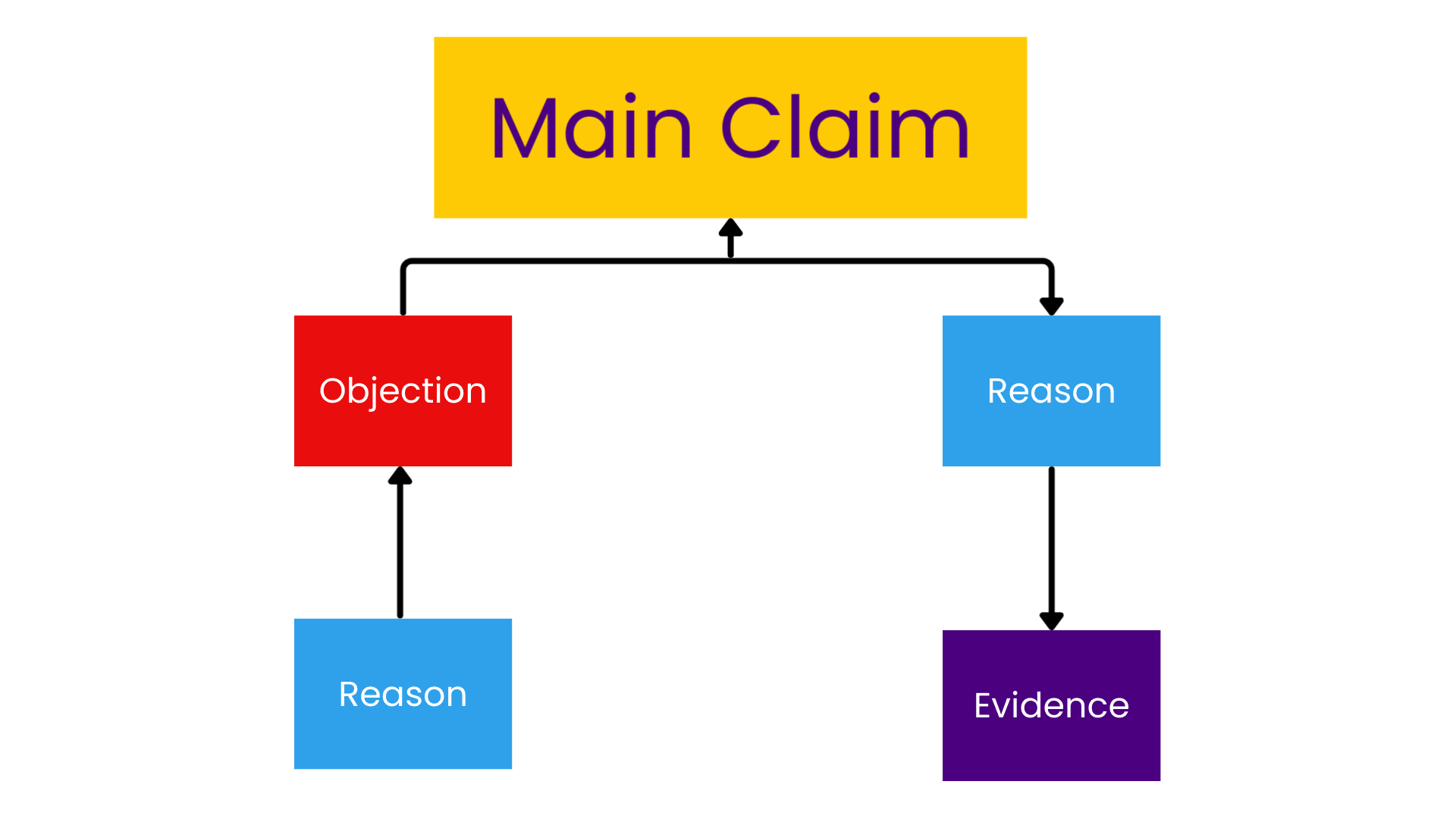
A simple argument map diagram showing a “Main Claim” at the top supported by a “Reason” and “Evidence,” along with an “Objection” connected to a counter-reason, illustrating the structure of logical argumentation.

Improves Critical Thinking Courses By Over 300%

Critical thinking courses that used argument mapping software saw students improve their critical thinking over 300% more than similar critical thinking courses.
Compared a standard logic class to one using argument mapping software. The mapping group made dramatically greater gains on a standardized critical thinking test, far exceeding typical semester improvements.
Source

One Semester Of Argument Mapping Produces 6-7x MORE Critical Thinking Gains Than One Semester Of Normal University Study

Semester-long CT courses using digital argument mapping consistently produced effect sizes of 0.7-0.85 on standardized critical thinking tests. By comparison, a typical university semester yields just 0.11
Source

9% Critical Thinking Gains In Just Weeks

Five weeks of an argument mapping-led course resulted in an average critical thinking gain of 9%
These gains were achieved with minimal explicit critical thinking teaching. The gains came from interactions with other students within argument mapping software.
Source


Debating develops the habits that critical thinking courses try to teach:

  • Dynamic reasoning — adapting ideas under pressure

  • Strategic thought — anticipating and countering objections

  • Cognitive discipline — structuring arguments with clarity and purpose

If debating is the clash of ideas, argument mapping is the architecture that makes clear thinking possible.
It’s the practice of breaking critical thinking into smaller parts — claims, evidence, objections, and assumptions — and arranging them so the logic becomes visible.

Argument mapping has been around for hundreds of years, used by philosophers, scientists, and modern critical-thinking educators to make critical thinking clearer by drawing it out.
And for good reason: when done well, argument mapping is one of the most effective ways to improve critical thinking and develop sharper logical reasoning.

Argument mapping helps you:

  • Clarify reasoning by revealing the actual structure of your thinking


  • Expose weak links that get lost in normal prose


  • Build precision through visual logic rather than persuasive writing tricks


These benefits make it a powerful method for anyone looking to enhance critical thinking skills, improve decision-making, or analyze arguments more effectively.

But traditional argument mapping has limits:

  • Pen and paper mapping is slow and quickly becomes cluttered
  • Digital mapping tools speed things up but remain static
  • And because the map never talks back, even skilled thinkers can hit writer’s block when faced with a silent diagram