Symbai thought leadership · What Auckland reveals about school debating

Debating is too important to run on teacher heroics.

Auckland’s 2026 data reveals a problem familiar to schools across New Zealand: debating needs little equipment and only a handful of students, yet too often a programme survives only because one person finds the time to keep it moving.

Analysis reviewed 8 October 2026 · Symbai

62 of 117schools in the reconciled Auckland comparison entered none of the three 2026 competition pathways studied
31regular-grade teams entered by St Cuthbert’s College alone
49 of 54regular-grade schools entered at least one grade configured for school-supplied adjudication
The paradox

Debating should be one of the easiest teams to start.

The Auckland data makes the paradox visible. No pitch. No kit. No squad the size of a rugby XV. Auckland Schools Debating’s regular formats ask for four to seven students per team, with three giving speeches. English and social sciences teachers already teach the foundations: claims, evidence, interpretation and clear expression.

A Junior Open or Senior Open entry costs NZ$149.50 at the standard 2026 rate, and ASD offers fee subsidies. Those are real costs, especially once transport is added. But debating’s physical prerequisites are unusually light. It should be able to travel across school boundaries more easily than many co-curriculars.

It does not. In the reconciled list used for this analysis, 62 of 117 Auckland schools recorded no entry in ASD’s regular grades, its weekend competitions or the Auckland Regional Championships. That is not a count of schools where students do not debate or want to. At the other extreme, St Cuthbert’s College entered 31 regular-grade teams. Once a debating culture takes hold, participation can grow far beyond a token team.

The visible debate lasts an hour. The invisible job runs all year.

School size and equity

Size helps. It does not decide.

We should not pretend roll and socioeconomic barriers are irrelevant. An exploratory school-level match shows meaningful relationships with participation. Smaller schools and those serving more students facing socioeconomic barriers are less likely to appear in the competition records. That is a reason to strengthen access, not to write off their students’ interest.

Yet team counts do not simply rise with roll. Among state schools in the reconciled 2026 reports, Lynfield College entered 17 regular teams with a roll of 2,017. Mount Albert Grammar School entered nine with 3,625 students; Avondale College entered six with 2,789. Roll cannot tell us who has built a durable programme.

17 teamsLynfield College · roll 2,017
9 teamsMount Albert Grammar · roll 3,625
6 teamsAvondale College · roll 2,789

These comparisons show variation, not why it occurs. The available entry data does not measure latent student demand or the staffing available at each school.

The hidden commitment

The adjudicator changes the equation.

In 2026, 275 of Auckland’s 442 regular-grade teams—62%—entered Junior Open or Senior Open. Those are the grades configured for school-supplied adjudication. Forty-nine of the 54 schools with a regular-grade team entered at least one of them.

ASD’s rules make the obligation concrete. Junior Open relies on teachers or approved students to adjudicate; Senior Open relies on teachers. One person may manage only one or two teams because they must also adjudicate. Both grades run five preliminary rounds. That commitment returns week after week.

275 / 442

regular-grade teams in school-adjudicated grades

5 rounds

for each Junior and Senior Open team, alongside a school-side adjudicator requirement

ASD already offers fee subsidies, online coaching and adjudicator training, a Request a Coach service and an Advanced Open online zone. These are practical access measures. This is not a criticism of ASD: its competitions are the very infrastructure we want more schools to reach.

Then someone has to align students, coaches, adjudicators, fixtures, rooms and travel. The teacher in charge of debating—the DebateTIC—often carries that coordination. A four-person team can be surprisingly hard to assemble every week when the same students have exams, rehearsals, sport and other commitments. The dataset cannot count those clashes, but the competition rules reveal how quickly a small team becomes a large scheduling job.

A school debating programme should survive its most dedicated teacher.

Introducing PracticeSpace

A New Zealand school debating network that can start with one student.

1 interested student
Matched across schools
Debate + AI-assisted adjudication
Feedback + another round
Self-sustaining school programme

Each debate produces a winner and feedback.
No season standings. No breaks. New teams next round.

Starting with one studentOffer regular debates without recruiting other students just to make up the numbers.
Larger schoolsDevelop peer coaches, substitutes and student adjudicators—and lock in their success.

PracticeSpace makes regular rounds possible at any starting size, helping new clubs reach self-sustaining scale and established clubs become less dependent on DebateTIC heroics.

See how PracticeSpace works →

The Two Most Effective Ways to Improve Critical Thinking

Unified in Symbai

Debating

Hundreds of thousands of students across 60 countries choose to spend their free time in formal debating competitions because it improves their critical thinking skills. 

Formal debating improves:

  • Dynamic reasoning — adapting ideas under pressure

  • Strategic thought — anticipating and countering objections

  • Cognitive discipline — structuring arguments with clarity and purpose

Increases Critical Thinking By Up To 50%

Competitive debate produces greater critical thinking improvement than argumentation courses.
Allen et al. measured the improvement using the Watson–Glaser critical-thinking test — a gold-standard assessment of inference, deduction, and evaluation skills.”
Source

8.6% Critical Thinking Gains In Just 3 Weeks

Students who participated in debate competition showed statistically significant improvements in critical thinking scores after just three weeks.
An 8.6% improvement in critical thinking is the cognitive equivalent of dropping your resting heart rate from 70 to 64 BPM. That's not learning facts or techniques — that's developing lasting cognitive fitness.
Source

9 in 10 former debaters go on to earn at least one advanced degree.

Of 703 National Debate Tournament alumni, over 90% held a graduate or professional degree, and many held multiple advanced degrees.
Of the 703 former NDT debaters; 40% earned master’s degrees (MA, MSc, MBA, MEd, etc.), 20% earned doctoral degrees (PhD, MD, EdD) and many held multiple advanced or professional degrees.
Source
Argument Mapping

Argument mapping has been around for hundreds of years, used by philosophers, scientists, and modern critical-thinking educators to make critical thinking clearer by drawing it out.
And for good reason: when done well, argument mapping is one of the most effective ways to improve critical thinking and develop sharper logical reasoning.

Argument mapping helps you:

  • Clarify reasoning by revealing the actual structure of your thinking
  • Expose weak links that get lost in normal prose
  • Build precision through visual logic rather than persuasive writing tricks
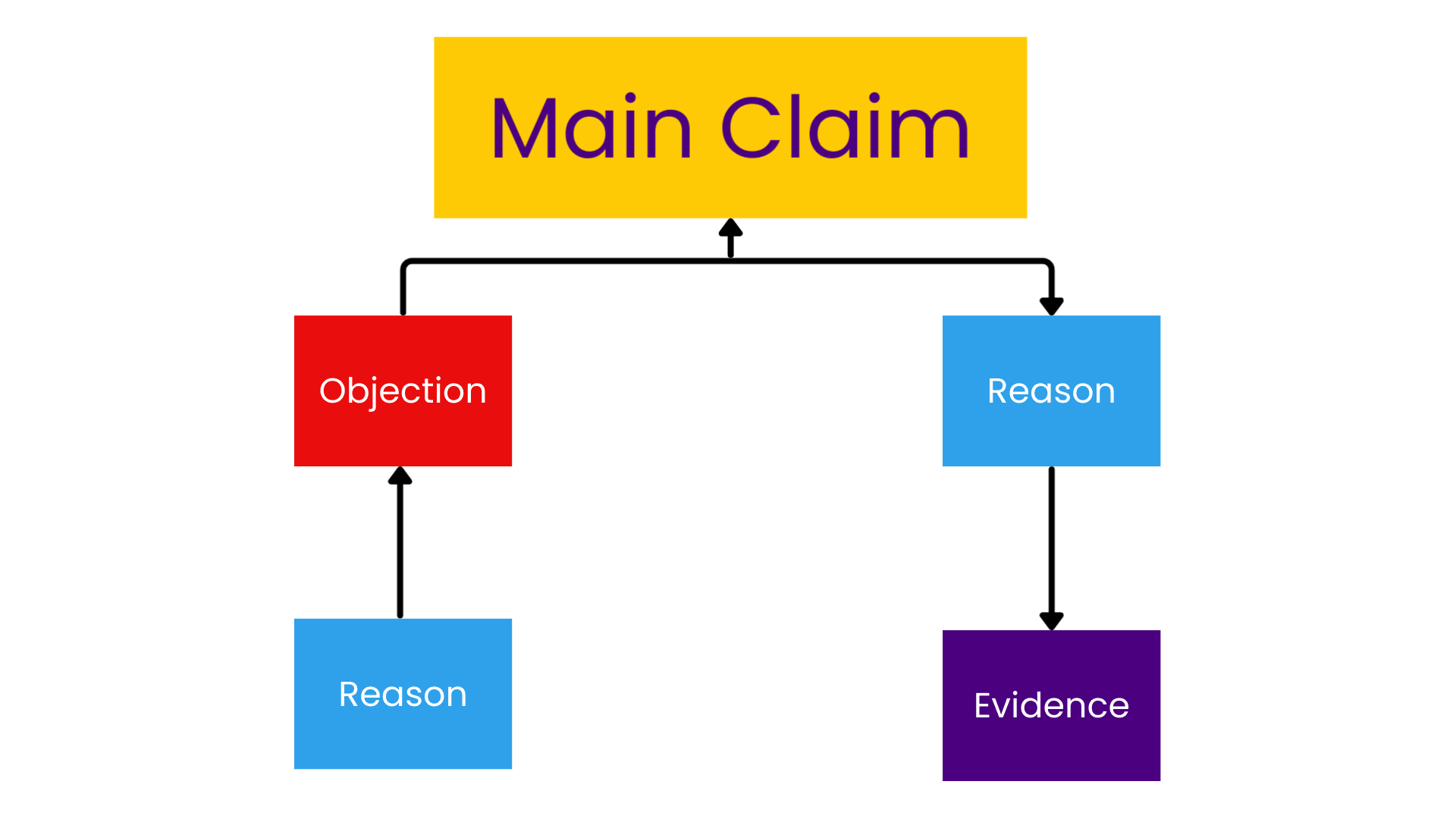
A simple argument map diagram showing a “Main Claim” at the top supported by a “Reason” and “Evidence,” along with an “Objection” connected to a counter-reason, illustrating the structure of logical argumentation.

Improves Critical Thinking Courses By Over 300%

Critical thinking courses that used argument mapping software saw students improve their critical thinking over 300% more than similar critical thinking courses.
Compared a standard logic class to one using argument mapping software. The mapping group made dramatically greater gains on a standardized critical thinking test, far exceeding typical semester improvements.
Source

One Semester Of Argument Mapping Produces 6-7x MORE Critical Thinking Gains Than One Semester Of Normal University Study

Semester-long CT courses using digital argument mapping consistently produced effect sizes of 0.7-0.85 on standardized critical thinking tests. By comparison, a typical university semester yields just 0.11
Source

9% Critical Thinking Gains In Just Weeks

Five weeks of an argument mapping-led course resulted in an average critical thinking gain of 9%
These gains were achieved with minimal explicit critical thinking teaching. The gains came from interactions with other students within argument mapping software.
Source


Debating develops the habits that critical thinking courses try to teach:

  • Dynamic reasoning — adapting ideas under pressure

  • Strategic thought — anticipating and countering objections

  • Cognitive discipline — structuring arguments with clarity and purpose

If debating is the clash of ideas, argument mapping is the architecture that makes clear thinking possible.
It’s the practice of breaking critical thinking into smaller parts — claims, evidence, objections, and assumptions — and arranging them so the logic becomes visible.

Argument mapping has been around for hundreds of years, used by philosophers, scientists, and modern critical-thinking educators to make critical thinking clearer by drawing it out.
And for good reason: when done well, argument mapping is one of the most effective ways to improve critical thinking and develop sharper logical reasoning.

Argument mapping helps you:

  • Clarify reasoning by revealing the actual structure of your thinking


  • Expose weak links that get lost in normal prose


  • Build precision through visual logic rather than persuasive writing tricks


These benefits make it a powerful method for anyone looking to enhance critical thinking skills, improve decision-making, or analyze arguments more effectively.

But traditional argument mapping has limits:

  • Pen and paper mapping is slow and quickly becomes cluttered
  • Digital mapping tools speed things up but remain static
  • And because the map never talks back, even skilled thinkers can hit writer’s block when faced with a silent diagram