
About Connor McFadyen

In Connors Words

“Symbai exists to make rigorous thinking accessible to anyone who wants to challenge their mind — not just those who already love to argue.

After six years of refining ideas from classrooms, coaching, and code, I built Symbai to make advanced argumentation easy to access — and even fun. It’s where technology meets the art of reasoning, helping you think more clearly, question more deeply, and engage with ideas that push you forward.”


 More About Connor

Co-taught Baradene’s History Scholarship Program — producing 13 scholarship winners and 4 outstanding scholars, all trained to argue with clarity and evidence.

  • Represented the University of Auckland at national and international debate championships, inspiring Symbai’s focus on clear, reasoned argument.
  • Winner and finalist in senior Auckland Schools Debating competitions.
  • Coached multiple championship teams and doubled student participation in debating & mooting as Head Coach at Baradene College.
  • Microsoft Innovative Educator 2022 & 2024
  • Holds a BA in Political Science and History 
The Two Most Effective Ways to Improve Critical Thinking

Unified in Symbai

Debating

Hundreds of thousands of students across 60 countries choose to spend their free time in formal debating competitions because it improves their critical thinking skills. 

Formal debating improves:

  • Dynamic reasoning — adapting ideas under pressure

  • Strategic thought — anticipating and countering objections

  • Cognitive discipline — structuring arguments with clarity and purpose

Increases Critical Thinking By Up To 50%

Competitive debate produces greater critical thinking improvement than argumentation courses.
Allen et al. measured the improvement using the Watson–Glaser critical-thinking test — a gold-standard assessment of inference, deduction, and evaluation skills.”
Source

8.6% Critical Thinking Gains In Just 3 Weeks

Students who participated in debate competition showed statistically significant improvements in critical thinking scores after just three weeks.
An 8.6% improvement in critical thinking is the cognitive equivalent of dropping your resting heart rate from 70 to 64 BPM. That's not learning facts or techniques — that's developing lasting cognitive fitness.
Source

9 in 10 former debaters go on to earn at least one advanced degree.

Of 703 National Debate Tournament alumni, over 90% held a graduate or professional degree, and many held multiple advanced degrees.
Of the 703 former NDT debaters; 40% earned master’s degrees (MA, MSc, MBA, MEd, etc.), 20% earned doctoral degrees (PhD, MD, EdD) and many held multiple advanced or professional degrees.
Source
Argument Mapping

Argument mapping has been around for hundreds of years, used by philosophers, scientists, and modern critical-thinking educators to make critical thinking clearer by drawing it out.
And for good reason: when done well, argument mapping is one of the most effective ways to improve critical thinking and develop sharper logical reasoning.

Argument mapping helps you:

  • Clarify reasoning by revealing the actual structure of your thinking
  • Expose weak links that get lost in normal prose
  • Build precision through visual logic rather than persuasive writing tricks
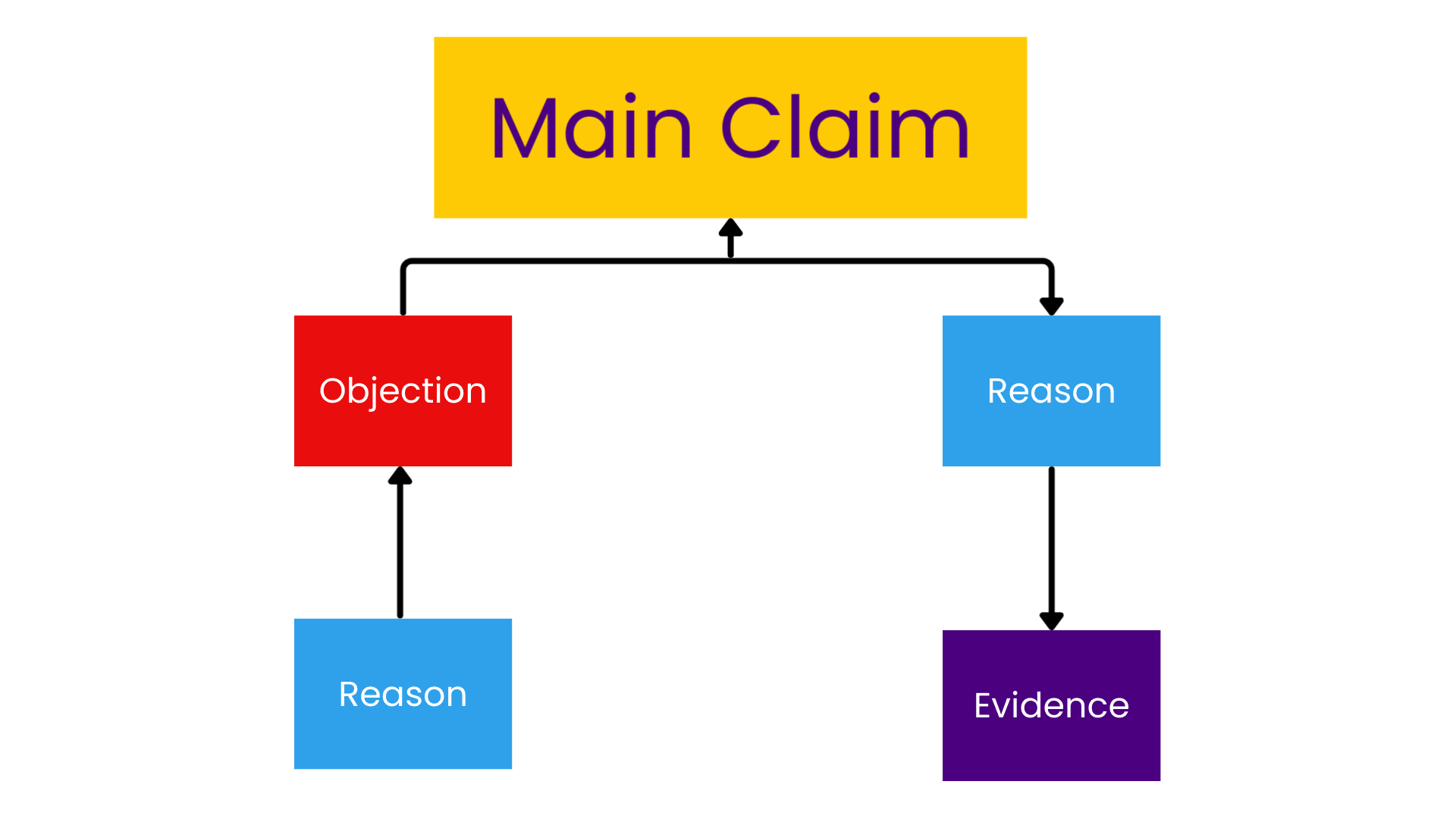
A simple argument map diagram showing a “Main Claim” at the top supported by a “Reason” and “Evidence,” along with an “Objection” connected to a counter-reason, illustrating the structure of logical argumentation.

Improves Critical Thinking Courses By Over 300%

Critical thinking courses that used argument mapping software saw students improve their critical thinking over 300% more than similar critical thinking courses.
Compared a standard logic class to one using argument mapping software. The mapping group made dramatically greater gains on a standardized critical thinking test, far exceeding typical semester improvements.
Source

One Semester Of Argument Mapping Produces 6-7x MORE Critical Thinking Gains Than One Semester Of Normal University Study

Semester-long CT courses using digital argument mapping consistently produced effect sizes of 0.7-0.85 on standardized critical thinking tests. By comparison, a typical university semester yields just 0.11
Source

9% Critical Thinking Gains In Just Weeks

Five weeks of an argument mapping-led course resulted in an average critical thinking gain of 9%
These gains were achieved with minimal explicit critical thinking teaching. The gains came from interactions with other students within argument mapping software.
Source


Debating develops the habits that critical thinking courses try to teach:

  • Dynamic reasoning — adapting ideas under pressure

  • Strategic thought — anticipating and countering objections

  • Cognitive discipline — structuring arguments with clarity and purpose

If debating is the clash of ideas, argument mapping is the architecture that makes clear thinking possible.
It’s the practice of breaking critical thinking into smaller parts — claims, evidence, objections, and assumptions — and arranging them so the logic becomes visible.

Argument mapping has been around for hundreds of years, used by philosophers, scientists, and modern critical-thinking educators to make critical thinking clearer by drawing it out.
And for good reason: when done well, argument mapping is one of the most effective ways to improve critical thinking and develop sharper logical reasoning.

Argument mapping helps you:

  • Clarify reasoning by revealing the actual structure of your thinking


  • Expose weak links that get lost in normal prose


  • Build precision through visual logic rather than persuasive writing tricks


These benefits make it a powerful method for anyone looking to enhance critical thinking skills, improve decision-making, or analyze arguments more effectively.

But traditional argument mapping has limits:

  • Pen and paper mapping is slow and quickly becomes cluttered
  • Digital mapping tools speed things up but remain static
  • And because the map never talks back, even skilled thinkers can hit writer’s block when faced with a silent diagram